Projects

Personalised SGLT2i treatment in diabetic kidney disease supported by multiparametric renal magnetic resonance imaging

Description

More than 10% of the world’s population have chronic kidney disease.

Diabetes mellitus is the leading cause of Chronic Kidney Disease, yet only some patients develop Diabetic Kidney Disease (DKD) and follow individual trajectories. Sodium–glucose cotransporter 2 inhibitors (SGLT2i) show strong nephroprotective benefits and are now first-line DKD therapy, but mechanisms driving variable responses remain unclear.

Early identification of patients likely to benefit is essential for personalised care and cost-effective treatment, requiring sensitive biomarkers of progression and therapeutic response.

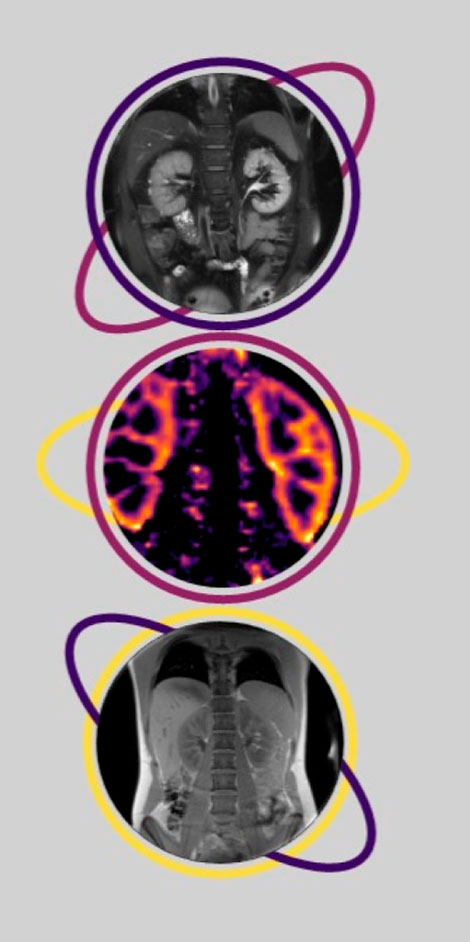
Renal multiparametric MRI and serum MMP-10/TIMP-1 offer promising insights into kidney pathophysiology and SGLT2i pathways. PERSONALISE-DKD will refine methods, validate biomarkers, and uncover early predictors of SGLT2i nephroprotection.

The PERSONALISE-DKD project is supported by the Italian Ministry of Health (Italy), Innovation Fond Denmark (Denmark), German Federal Ministry of Education and Research (Germany), Gobierno de Navarra (Spain), Executive Agency for Higher Education, Research, Development and Innovation Funding (Romania), Latvian Council of Science (Latvia), under the frame of EP PerMed.

Objectives

PERSONALISE-DKD aims to

Investigate SGLT2i nephroprotective mechanisms in DKD rapid and slow progressors

Assess SGLT2i effect on renal microstructure and MMPs-related pathways

Preclinically identify renal mpMRI biomarkers most sensitive to acute and chronic SGLT2i effects in DKD

Identify the optimal biomarker combinations and develop predictive models allowing to monitor disease progression and response to SGLT2i in DKD

Ensure reflection on ethical, legal and social issues, and promote active involvement of patients, citizens and other stakeholders

To develop MRI data sharing guidelines ensuring ethics and confidentiality, and assess patient, health care and ethic professionals.


Partners

Anna Caroli

Coordinator

Title: PhD
Institution: Istituto di Ricerche Farmacologiche Mario Negri IRCCS (IRFMN)

Via Camozzi 3. Postal Code 24020
Ranica (BG) Italy

Maria A. Fernández Seara

Project partner 1

Title: Dr
Institution: Institution Clínica Universidad de Navarra (UNAV)

Pio XII, 36. Postal Code 31008
Pamplona. Spain

Christoffer Laustsen

Project partner 2

Title: Head of Department, Associate Professor
Institution: Aarhus University (AU)

Palle Juul Jensens Boulevard 99. Postal Code 8200 Aarhus N. Denmark

Frank Zoellner

Project partner 3

Title: Prof. DR
Institution: Heidelberg University (UHEI)

Theodor-Kutzer-Ufer 1-3. Postal Code 68167 Mannheim, Germany

Lucian-Mihai Itu

Project partner 4

Title: PhD
Institution: Siemens SRL

B-dul Eroilor 3A. Postal Code 500007 Brasov. Romania

Signe Mezinska

Project partner 5

Title: Dr.sc.soc, MSc Bioethics
Institution: University of Latvia (UL)

Elgavas iela 3, Zemgales priekšpilsēta Rīga, LV-1004, Latvia

Juan Carlos Julián Mauro

Project partner 6

Title: PhD
Institution: European Kidney Patients Federation (EKPF) (UL)

35 Constancia St. Local 2. Madrid 28002 (Spain)

Network

Work packages

PERSONALISE-DKD is divided into 6 complementary and interlinked work packages (WPs).

WP1
Project management (M1–M36)

Lead: IRFMN
Participating:All partners

Task

Title

Timeline

Lead

T1.1

Project management

M1–M36

IRFMN

T1.2

Risk management and contingency plan

M1–M36

IRFMN


Preclinical research (M1–M36)

Lead: UHEI
Participating: UHEI, AU

Task

Title

Timeline

Lead

T2.1

Experimental design

M1–M12

UHEI

T2.2

Acute effects of SGLT2i: Imaging experiments

M13–M24

AU

T2.3

Chronic renal effects of SGLT2i: Imaging experiments

M13–M24

UHEI

T2.4

Urine and tissue renal kidney damage markers

M13–M24

AU

T2.5

Does renal metabolic MRI predict treatment effects?

M25–M36

AU


Exploratory Clinical Study (M1–M36)

Lead: IRFMN
Participating: IRFMN, UNAV, AU, UL, EKPF

Task

Title

Timeline

Lead

T3.1

Study protocol

M1–M6

IRFMN

T3.2

Study delivery

M7–M30

IRFMN

T3.3

Statistical analysis

M13–M36

UNAV


Data management, analysis, and mining (M1–M36)

Lead: SIE
Participating: UHEI, UNAV, AU, IRFMN

Task

Title

Timeline

Lead

T4.1

Central Database

M1–M36

SIE

T4.2

MRI data quality control and processing

M7–M30

UHEI

T4.3

Image normalisation and Radiomics feature extraction

M13–M30

UHEI

T4.4

DeepReasoner for clinical decision support

M1–M36

SIE


Ethical, legal and social issues (M1–M36)

Lead: UL
Participating: All partners

Task

Title

Timeline

Lead

T5.1

Mapping ELSI challenges

M1–M24

UL

T5.2

Developing informative materials for patients and the general public

M20–M32

UL

T5.3

Developing ethical decision-making support tool

M24–M36

UL

T5.4

Compliance with legal and ethical requirements

M1–M36

UL


Dissemination and exploitation (M1–M36)

Lead: UNAV
Participating: All partners

Task

Title

Timeline

Lead

T6.1

Dissemination and communication

M1–M36

UNAV

T6.2

Exploitation and IPR protection plan

M13–M36

SIE


Milestones

MilestoneMonthWPMeans of verification
M.1 Clinical study protocol approved, and 1st patient enrolledM6WP3D3.1
M.2 Experimental studies designed and approvedM12WP2D2.1
M.3 Project website launchedM12WP6D6.2
M.4 Clinical study enrolment completedM18WP3D3.2
M.5 Workshop for mapping of ELSI challengesM23WP5D5.1
M.6 Experimental studies completedM24WP2D2.2, D2.3, D2.4
M.7 Image data processing pipeline implementedM24WP4D4.2, D4.3
M.8 Workshop for development of informative materialsM30WP5D5.2
M.9 Experimental data analyses completedM36WP2D2.5
M.10 Clinical study completedM36WP3D3.4
M.11 Clinical data analyses completedM36WP3D3.5
M.12 Clinical decision support system implementedM36WP4D4.4